
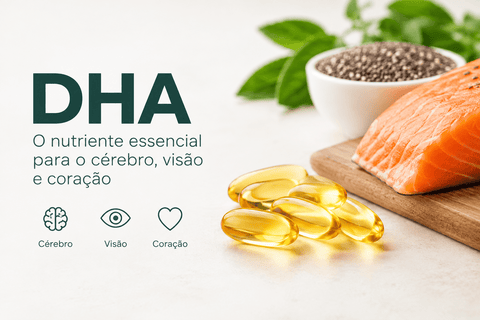
A new clinical trial, reported by NutraIngredients, suggests that combining vitamin D and DHA may support cognitive function in older adults more consistently than either nutrient taken alone. Viva Saudável explains what was tested, what the results show, and where caution is needed.
What the study on vitamin D and DHA found
The news was reported by NutraIngredients, a leading publication in the nutrition and supplements sector. The research was conducted by a team from Tianjin Medical University in China and published in the scientific journal Nutrients. It involved 355 participants over 65 with mild cognitive impairment — a stage where measurable changes in memory or reasoning already exist, but without significant impact on daily autonomy.
Participants were randomly assigned to four groups and took a daily supplement for 12 months: vitamin D3 (800 IU per day), DHA (1 g per day), the combination of both at the same doses, or placebo. Neither the participants nor the researchers knew who was in which group, which strengthens the reliability of the conclusions.
At 6 and 12 months, cognitive function was assessed using clinical scales. In parallel, the team measured five blood markers linked to neuroinflammation mediated by the NLRP3 pathway and pyroptosis — a form of programmed inflammatory cell death present in various brain aging processes.
After 12 months, the three groups that took supplements showed improvements in cognitive scores and reductions in the five markers, compared to the placebo. The combination of vitamin D3 and DHA stood out: researchers described superior cognitive improvements across several subscales and a more pronounced reduction in inflammatory markers compared to each nutrient alone.
The authors themselves urge caution. They consider the results an encouraging sign of an accessible nutritional strategy for early intervention but emphasize that larger, longer-term trials are needed to confirm them.
Why the combination makes sense, according to researchers
The trial did not emerge out of nowhere. It builds on four ideas that previous research had already raised about how each nutrient interacts with the brain.
Vitamin D3 has receptors in the brain
It binds to receptors present in brain tissue and, in previous studies, has been associated with modulating neuroinflammation. An important detail: the optimal blood levels for cognition are not yet defined in clinical guidelines.
DHA is part of neuron structure
It is the most abundant omega-3 in the brain. It contributes to the fluidity of neuronal membranes and communication between nerve cells, and has been associated with stimulating neuroprotective factors, such as BDNF.
Mechanisms seem complementary
Previous evidence suggests that DHA may influence vitamin D receptor activation. The researchers' hypothesis was simple: two nutrients acting through different but linked pathways could have a greater effect together.
A common target: neuroinflammation
The study measured markers of the NLRP3 pathway and pyroptosis. The combination reduced them more than each nutrient alone — a possible mechanism to explain the results, which still needs to be confirmed.
Trial doses, and what this study doesn't say
Limitations to consider
- This is a single trial, in a single population (Chinese adults over 65). Results may not apply to younger people or those without cognitive changes.
- It shows improvements in cognitive scores and blood markers — it does not show prevention of any disease or structural changes in the brain.
- Twelve months is a relevant period, but short for assessing long-term cognitive evolution.
Vitamin D and DHA on your plate and in your routine
Before any supplement, it's worth looking at everyday sources. None of them replace the trial doses, but all contribute to the foundation on which any supplementation should be based.
Sardines and mackerel
Fatty fish, accessible and seasonal in Portugal. Among the richest dietary sources of EPA and DHA.
Salmon and herring
Other consistent sources of DHA. Two servings of fatty fish per week is the usual reference in dietary recommendations.
Morning sun, in moderation
The skin produces vitamin D with sun exposure. In autumn and winter, synthesis decreases significantly — hence the interest in knowing levels at this time of year.
Egg yolk
Contains vitamin D and some amount of DHA, especially in eggs enriched with omega-3s.
Algae and microalgae
Direct plant source of DHA. A relevant alternative for those who do not eat fish.
Fortified foods
Milks, plant-based beverages, and some cereals fortified with vitamin D. It's worth reading the label.
Walnuts, flaxseed, and chia
Provide ALA, an omega-3 that the body converts into DHA in small proportions. Useful, but does not replace direct DHA.
Movement, sleep, and social interaction
In the trial, supplements were an addition, not a substitute. Physical activity, regular sleep, and social life continue to be the foundation.
When to talk to a doctor before considering supplements
- Forgetfulness that begins to interfere with daily tasks
- Disorientation in familiar places
- Difficulty following conversations or finding words
- Mood or behavior changes noticed by family members
These signs warrant medical evaluation. A supplement is not the answer for any of them and should not delay such a consultation.
Smart supplementation: a complement, not a shortcut
Food supplements are meant to complement a balanced diet, not replace it. In the case of vitamin D, the most useful starting point is a blood test (25-hydroxyvitamin D), which helps determine if there is a need and to calibrate the dose. For DHA, regular consumption of fatty fish already covers a significant part of the requirements.
The doses used in the trial — 800 IU of vitamin D3 and 1 g of DHA per day — are higher than a standard dose of most available supplements. This is not a flaw in the products: it reflects the fact that the study was designed for a specific clinical group. The correct dose for each person depends on blood levels, diet, age, and ongoing medication, and should be defined with a healthcare professional.
The products below were selected because they contain the nutrients studied, have independent purity certification, and allow for flexible dosing. The statements about their effects correspond only to the health claims authorized in the European Union.
UnoCardio 1000 Mini — 600 mg Omega-3 + Vitamin D3
WHC Labs · 30 softgels
Why it may help
Combines the two nutrients tested in the trial in one capsule: 600 mg of omega-3 (335 mg of EPA and 230 mg of DHA) and 25 µg (1000 IU) of vitamin D3. EPA and DHA contribute to the normal function of the heart; vitamin D contributes to the normal function of the immune system and the maintenance of normal bones and muscles. Concentrated fish oil in triglyceride form (rTG), with IFOS 5-star certification, free from gluten, soy, lactose, and sugars.
How to use
1 capsule daily, with a meal containing fat, unless otherwise directed by a healthcare professional. The trial doses were higher than one capsule; any adjustment should be monitored.
Omega Superb Liquid Lemon Berry 250 ml
Thorne Research
Why it may help
Liquid fish oil with concentrated EPA and DHA per teaspoon, for those who prefer to avoid capsules or want more flexible dosing. DHA contributes to the maintenance of normal brain function and normal vision — an effect obtained with a daily dose of 250 mg of DHA. IFOS 5-star certification and sustainable fishing.
How to use
1 teaspoon daily, preferably with a meal, unless otherwise directed by a healthcare professional.
Liquid Vitamin D 30 ml
Thorne Research
Why it may help
12.5 µg (500 IU) of vitamin D3 per drop, in a medium-chain triglyceride base, without preservatives. Allows for precise dose adjustment after knowing blood levels. Vitamin D contributes to the normal function of the immune system and the maintenance of normal bones, teeth, and muscles.
How to use
The number of drops should be determined with a healthcare professional, ideally based on a recent 25-hydroxyvitamin D analysis.
Vitamin D-1000, 90 capsules
Thorne Research
Why it may help
25 µg (1000 IU) of vitamin D3 per capsule, without preservatives or lactose — a fixed daily dose, similar to that used in the trial, in a simple format for those who prefer capsules. Same authorized claims: immune system, bones, and muscles.
How to use
1 capsule daily, with a meal, or as directed by a healthcare professional.
Food supplements are not a substitute for a varied and balanced diet or a healthy lifestyle. They are not intended to treat, prevent, or diagnose any disease. In case of pregnancy, breastfeeding, illness, or ongoing medication, consult your doctor before starting any supplement. Do not exceed the recommended daily intake.
Frequently asked questions
Does this study prove that supplementing with vitamin D and DHA protects memory?
No. It shows improvements in cognitive scores and blood markers in a specific group — adults over 65 with mild cognitive impairment — over 12 months. The authors themselves call for larger and longer trials before drawing general conclusions.
Are the doses in the study the doses I should take?
Not necessarily. The 800 IU of vitamin D3 and 1 g of DHA were defined for the trial and taken with supervision. The appropriate dose for each person depends on blood levels, diet, age, and ongoing medication — it should be defined with a healthcare professional.
Does it make sense to test vitamin D levels before supplementing?
Yes. It is the most objective way to know if there is a need and to calibrate the dose. The usual test measures 25-hydroxyvitamin D in the blood. Without this reference, supplementing blindly can be insufficient or excessive.
Who should talk to a doctor before combining omega-3 and vitamin D?
Anyone taking anticoagulants or antiplatelets, anyone with calcium disorders or kidney disease, pregnant and lactating women, and anyone who notices changes in memory or reasoning. In the latter case, medical evaluation comes before any supplement.
Science advances with trials like this: a promising, well-designed signal that calls for confirmation — not a shortcut.
The Tianjin study adds an interesting piece to the puzzle of nutrition and cognitive aging: two well-known nutrients, tested together, with consistent results over a year. Still, a cautious reading is the most useful. Ensuring sufficient vitamin D and DHA through diet, knowing your own levels, and, when appropriate, supplementing with supervision is a solid path. A complete routine is always worth more than an isolated capsule.
Sources
- Richards, L. «Could vitamin D and DHA be a winning team for cognitive decline?», NutraIngredients, September 4, 2026. nutraingredients.com
- Yuan, J. et al. "Effects of a Combined Vitamin D3 and Docosahexaenoic Acid Intervention on Cognitive Function and Blood Pyroptotic Biomarkers in Older Adults with Mild Cognitive Impairment: A 12-Month Randomized, Double-Blind, Placebo-Controlled Trial", Nutrients, 2026. doi.org/10.3390/nu18172777
- European Union Register of nutrition and health claims, under Regulation (EC) No 1924/2006 — authorized claims for DHA and vitamin D.
Omega-3 and Vitamin D with Verified Purity
- IFOS 5-star certified fish oils
- Vitamin D3 in drops or capsules, for precise dosing
- Clinical reference brands, such as WHC Labs and Thorne Research
Viva Saudável selects supplements with transparent composition and independent certification. If in doubt about dosages, the team always recommends speaking to a healthcare professional.
Comments (0)
There are no comments for this article. Be the first one to leave a message!