
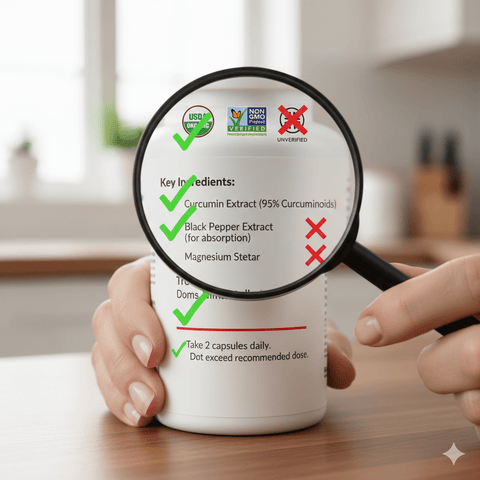
How to identify reliable supplements (just by looking at the label)
You already know that not all supplements are created equal. Some are rigorously tested, others barely pass basic quality control. Some use premium ingredients, others fill the capsules with cheap additives.
But how do you distinguish one from the other without being an expert ?
The good news: you don't need a lab or a degree in biochemistry. You just need to know what to look for — and what to avoid — when picking up a bottle of supplements.
This guide will teach you exactly that.
Step 1: Look for independent certifications.
The first rule for identifying a reliable supplement is simple: don't just trust the brand's word.
Any company can write "laboratory tested" or "quality guaranteed" on the label. But that means nothing without independent certifications —that is, audits conducted by external entities that rigorously and impartially test products.
These are the certifications that really matter:
🐟 IFOS (International Fish Oil Standards) — For Omega 3
IFOS is the most stringent international standard for fish oils. IFOS-certified products are tested for:
- Purity: absence of heavy metals (mercury, lead, arsenic, cadmium)
- Contaminants: PCBs (polychlorinated biphenyls), dioxins and furans
- Oxidation: a guarantee that the oil is fresh and not rancid.
- Potency: confirmation that the EPA and DHA dose on the label matches reality.
IFOS uses a star rating system , from 1 to 5:
⭐ = Basic Quality
⭐⭐⭐⭐⭐ = Maximum quality, safety and transparency
What to look for on the label:
IFOS logo or mention of 5-star certification. Reputable brands make batch reports available online.
Example: The EnerZona Omega 3 RX is IFOS 5-star certified, with published tests showing:
- EPA: 420 mg/capsule (above the stated amount)
- DHA: 230 mg/capsule (above the stated amount)
- Mercury: <0.005 ppm (well below the 0.1 ppm limit)
- PCBs: 2.04 ppb (limit is 45 ppb)
- Oxidation (TOTOX): 14.71 (limit is 19.5)
That's total transparency .
🏅 NSF Certified for Sport® — For athletes and pharmaceutical quality
NSF for Sport certification guarantees that:
- The product does not contain any banned substances (WADA list — World Anti-Doping Agency).
- Each batch is tested for cross-contamination.
- Manufacturing follows strict hygiene and control standards.
This certification is required by professional athletes and elite teams, including the NBA, NFL, NHL, and U.S. National Teams.
What to look for on the label:
"NSF Certified for Sport" logo with certification number.
Example: Thorne has over 25 products with NSF for Sport certification, and is the exclusive supplier to several world champion teams.
🇦🇺 TGA (Therapeutic Goods Administration) — Australia
The Australian TGA is widely recognized as the world's most stringent regulatory agency for therapeutic products.
Obtaining TGA certification means:
- Compliance with pharmaceutical manufacturing standards
- Complete traceability of raw materials.
- Regular on-site audits
- Extremely high labeling and safety requirements.
Only a handful of American companies have achieved this certification.
What to look for on the label:
Mention of TGA certification or TGA "A" rating.
Example: Thorne was the first US supplement company to be fully certified by the TGA , maintaining an A rating.
✅ cGMP (Current Good Manufacturing Practices) — FDA
FDA (U.S. Food and Drug Administration) cGMP certification ensures that manufacturing follows good manufacturing practices , similar to those required for pharmaceuticals.
This includes:
- Quality control at all stages
- Calibrated and validated equipment
- Rigorous employee training
- Complete documentation for each batch produced.
What to look for on the label:
Mention of "cGMP certified facility" or "FDA registered facility".
Important detail: Thorne has an impeccable record — she has never received a non-compliance notice (FDA Form 483) from any inspection.
Step 2: Read the list of ingredients (all of them).
Most people only look at the active ingredients (vitamins, minerals, omega-3s, etc.). But the inactive ingredients —also called "excipients"—are equally important.
✅ What should be included:
Bioavailable forms of nutrients
Not all forms of vitamins and minerals are absorbed in the same way.
Examples of higher-level forms:
- Vitamin B12: methylcobalamin or adenosylcobalamin (active)
- Folate: 5-MTHF (active), not synthetic folic acid.
- Magnesium: bisglycinate or threonate (high absorption)
- Vitamin D: D3 (cholecalciferol), not D2
Natural antioxidants (in oils)
Fish oils should include:
- Mixed tocopherols (natural vitamin E)
- Rosemary extract
- Ascorbyl palmitate (fat-soluble vitamin C)
These ingredients prevent oxidation and keep the oil fresh.
Clear and complete doses
The label should indicate exactly how much of each active ingredient is present. Be wary of "proprietary blends" that hide individual serving sizes.
❌ What you should avoid:
Magnesium stearate
Used as a lubricant in capsule manufacturing. The problem? It can create a film that hinders the dissolution of the capsule in the stomach, reducing nutrient absorption.
Quality brands, such as Thorne, never use magnesium stearate .
Artificial colors and flavors
They are purely aesthetic — they offer no health benefits. Furthermore, some colorants (such as titanium dioxide) raise long-term safety concerns.
Unnecessary fillers
Examples: talc, silica, microcrystalline cellulose in excess. They occupy space that could be filled with active ingredients.
Aggressive preservatives
BHT, BHA, and parabens are synthetic preservatives that can be avoided with good manufacturing practices and proper packaging.
Vague "proprietary blends"
If the label says "Antioxidant Blend 500mg" but doesn't specify how much of each ingredient, that's a warning sign . Total transparency is mandatory.
Step 3: Verify the testing process.
We've already looked at the certifications. Now, let's go deeper: how many times has the product been tested?
Most brands test supplements once or twice (usually just the raw materials). The best brands test them four times .
The 4 testing phases (gold standard):
Phase 1 — Raw materials
Before any ingredient enters the production line, it is tested for:
- Chemical identity (is it really the declared ingredient?)
- Potency (correct concentration?)
- Purity (absence of contaminants?)
Contaminants tested include:
- Heavy metals (lead, mercury, arsenic, cadmium)
- Pesticides
- Residual solvents
- Mold and bacteria
- Prohibited substances
Phase 2 — During manufacturing (in-process testing)
While the product is being manufactured, continuous checks are performed:
- Are the correct doses being used?
- Are there any defects in the capsules, labels, or bottles?
- Are the temperature and humidity under control?
Phase 3 — Final Product
Before being sold, the finished product is tested again:
- Confirmation of the identity, potency, and purity of the final formula.
- Verification that there was no microbiological contamination during manufacturing.
- Dissolution tests (does the capsule dissolve within the expected time?)
Phase 4 — Stability
The product is tested over time to ensure it maintains its quality until its expiration date .
This is especially important for sensitive ingredients, such as oils (which can oxidize) and probiotics (which can lose viability).
Practical example: Thorne performs these 4 testing phases in its own laboratories, with state-of-the-art equipment and highly qualified chemists.
Step 4: Confirm brand transparency.
Certifications and tests are essential, but there's another crucial indicator of trust: does the brand share information openly?
Signs of a transparent brand:
✅ Provides online test reports
Reputable brands publish Certificates of Analysis (COAs) for each batch. You can verify exactly what was tested and what the results were.
✅ Explains the origin of the ingredients
Where does fish oil come from? Which species are used? How is it purified?
✅ There is a "No List"
A public list of ingredients that will never be used in products (example: Thorne has an extensive "No List").
✅ Answers technical questions
Can customer support answer questions about chemical forms, bioavailability, and interactions?
✅ Has a history of regulatory compliance
Have you never had any recalls? Have you never been fined for misleading advertising or non-compliance?
Warning signs (lack of transparency):
❌ Does not provide COAs or test reports.
❌ Uses vague language in marketing ("tested in a laboratory" without specifying which one)
❌ Does not answer technical questions or hides behind "trade secrets"
❌ You have a history of recalls or regulatory issues.
❌ The site is more focused on aggressive marketing than on education.
Step 5: Be wary of prices that seem "too good to be true".
Quality comes at a cost. Rigorous testing, premium ingredients, international certifications — it's all expensive.
Does this mean you have to pay a fortune? Not necessarily. But it does mean you should be wary of extremely cheap supplements .
If an omega-3 supplement costs half the price of the competition, ask yourself:
- Where are they cutting costs?
- Do they test less?
- Do they use inferior quality oil?
- Do they add cheap fillers?
Rule of thumb: Always compare the cost per effective dose , not just the price of the bottle.
Example:
- Product A: 30 capsules of 300mg EPA+DHA = R$ 15 → R$ 0.50 per 300mg serving
- Product B: 60 capsules of 600mg EPA+DHA = R$ 35 → R$ 0.29 per 300mg serving
Product B may seem more expensive, but it's more economical per effective dose —and probably of higher quality.
Final checklist: Is your supplement reliable?
Before buying (or continuing to take) any supplement, ask yourself these questions:
□ Do you have independent certifications? (IFOS, NSF, TGA, cGMP)
□ Does the label list ALL the ingredients, both active and inactive?
□ Does it avoid stearates, artificial colors, and unnecessary fillers?
□ Do you use bioavailable forms of nutrients? (methylcobalamin, 5-MTHF, etc.)
Does the brand disclose its testing and processes?
□ Do you have a record of compliance with regulatory authorities?
Does the price reflect the quality without being excessive?
If you answered "no" to more than 2 questions, it's time to reconsider.
Two practical examples that meet all the criteria.
🐟 EnerZona Omega 3 RX
Certifications:
- IFOS 5 stars (maximum rating)
Transparency:
- Test reports published online for each batch.
- Actual concentration higher than labeled (420mg EPA, 230mg DHA per capsule)
Purity:
- Mercury: <0.005 ppm (20 times below the limit)
- PCBs: 2.04 ppb (22 times below the limit)
- Oxidation (TOTOX): 14.71 (well below the limit of 19.5)
Technology:
- Entericare Capsules (intestinal dissolution, no reflux)
- Mixed tocopherols, ascorbyl palmitate and rosemary extract (natural antioxidants)
🧬 Thorne B Complexes
Certifications:
- TGA (Australia) — A classification
- NSF Certified for Sport
- cGMP (FDA) — flawless registration
Transparency:
- "No List" public (ingredients they never use)
- 4 documented phases of laboratory testing
- Clearly identified bioavailable forms
Purity:
- Zero stearates
- Zero artificial colors or flavors.
- Zero unnecessary fillers
- Clinically validated ingredients
Conclusion: knowledge is power
Now you know how to distinguish a reliable supplement from a mediocre product— without needing to be an expert .
Independent certifications. Total transparency. Bioavailable ingredients. 4-phase testing. No unnecessary additives.
These are the pillars of a supplement that truly works — and that doesn't put your health at risk.
When memory, focus, and brain health are at stake, proven quality is the only safe choice.
The next time you pick up a bottle of supplements, don't just read the fancy name or believe the marketing promises.
Look at the label. Ask the right questions. And choose wisely.

Comments (0)
There are no comments for this article. Be the first one to leave a message!