
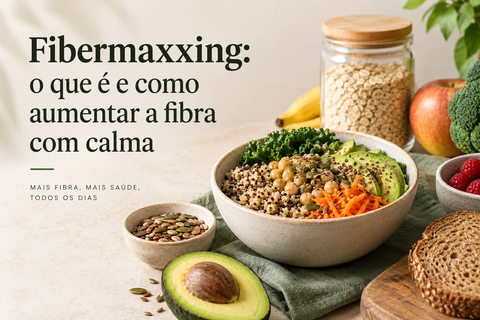
Fibermaxxing: eating more fiber, with calm and caution
For years, almost all the talk was about protein. Now, it is fiber that dominates the conversation, and fibermaxxing — consciously increasing the amount of fiber in your daily diet — has reached everyday questions. It makes sense that it is gaining traction: most adults fall below reference values.
What is fibermaxxing and why is everyone talking about it
The term was born on social media and describes a simple idea: looking at fiber with the same attention that many people started giving protein. In practice, it means choosing meals that add fiber throughout the day — legumes at lunch, fruit with the skin on as a snack, whole grains instead of refined ones — rather than leaving the issue to chance.
The interesting part is that, behind the buzzword, is an old and consensual nutritional recommendation. Fiber is the part of plant foods that the body does not digest in the small intestine and which reaches the colon practically intact. That is where it serves as a substrate for gut bacteria and contributes to the volume and consistency of stools.
The less interesting part — and the one that rarely appears in 30-second videos — is that increasing fiber too quickly usually goes wrong. Bloating, gas, and discomfort are the predictable response of a gut that hasn't had time to adapt. Fibermaxxing done right is slow, gradual, and accompanied by water.
How to increase fiber without turning your week into discomfort
Four principles that summarize a cautious approach to this topic.
Start with food
Vegetables, fruit, legumes, nuts, and whole grains remain the foundation. Before thinking about supplements, it's worth looking at your plate and realizing where you lack vegetables and legumes.
Increase slowly
Those starting from a fiber-poor diet benefit from adding a few grams at a time, over the course of weeks. Digestive tolerance improves with repeated exposure, not with a sudden jump.
Drink plenty of water
Various fibers absorb liquid and increase in volume. Without enough water, the effect can be exactly the opposite of what was intended. Water and fiber always go together.
Vary your sources
There is no single "fiber." Different foods bring different types, which is why many formulas combine various origins instead of betting on just one.
How much fiber is needed daily
European reference values point to about 25 grams daily for adults. Several countries recommend slightly higher ranges, especially for people with higher energy intake or more physical activity. It serves as a compass, not a rigid goal.
A rate of increase that the gut usually tolerates
Instead of going from 12 to 25 grams over a weekend, increasing a few grams at a time and maintaining that level for a few days allows the digestive system to adapt. Always accompany this with a proportional increase in fluids. In case of persistent digestive symptoms, unexplained changes in bowel movements, or known medical conditions, the path is to speak with a doctor or nutritionist before changing anything.
Eight sources of fiber that fit into a normal week
Approximate values per typical serving, useful only as an order of magnitude.
Cooked chickpeas
One of the densest sources. A ladle at lunch changes the day's tally.
Lentils
They cook quickly and fit into soups, salads, and stir-fries effortlessly.
Rolled oats
A source of beta-glucans. Practical for breakfast, alone or with yogurt.
Whole rye bread
A simple swap from white bread, with a relevant difference in the daily total.
Pears or apples with skin
A good part of the fiber is in the peel. Peeling cuts out a slice of the benefit.
Chia seeds
They form a gel when hydrated. A tablespoon in yogurt or a smoothie is enough.
Almonds
A handful as a snack adds fiber, unsaturated fat, and some protein.
Broccoli and cabbage
Volume on the plate with few calories and a good contribution of fiber.
Not all fibers behave the same way
Fiber is a collective name. Some dissolve in water and form a gel — such as psyllium, fruit pectin, or oat beta-glucans. Others do not dissolve and act primarily through the volume they add, as is the case with most of the fiber in whole grains and vegetable skins.
There is also a subgroup that is particularly interesting for the microbiota: fermentable fibers such as inulin and fructooligosaccharides (FOS), used by colon bacteria as a substrate. It is from this fermentation that short-chain fatty acids result, including butyrate.
It is also why many products combine various sources into a single mixture instead of limiting themselves to one. From a food perspective, the logic is identical: varying is wiser than repeating the same food over and over.
When a fiber supplement might make sense
A fiber supplement is exactly that: a supplement. It does not replace vegetables, fruit, or legumes, nor does it compensate for an unbalanced dietary pattern. It can, however, be a practical help for those who have difficulty reaching reference values through diet.
Most of these products provide between 4 and 10 grams of fiber per dose. This is why powder format is usually more convenient: it mixes into water, yogurt, or a smoothie. For the same amount in capsules, many units would be needed per intake.
Three notes before choosing. First: some fibers absorb a lot of liquid and increase in volume, so they should be taken with plenty of water. Second: those who have a low usual intake should increase gradually. Third: fiber can interfere with the absorption of medications — it is always worth reading the label, and in many products, an interval of 1 to 2 hours between medication and supplement is recommended.
Psyllium Husk powder — 340 g
Why it can help: psyllium (Plantago ovata) is one of the most studied soluble fibers and most used as a food supplement. It forms a gel upon contact with water and is a simple way to add fiber to a routine where diet does not always keep up. According to the European Union Register of claims, psyllium fiber contributes to the maintenance of normal bowel transit, with this effect obtained with a daily intake of 7 g, accompanied by sufficient liquid.
Apple Fiber powder — 340 g
Why it can help: fiber obtained from apple pulp, which naturally brings together soluble and insoluble fiber in one source. Simple formula, with a discreet flavor, designed for those who prefer to add fiber without complex mixtures.
Glucomannan 575 mg — 180 capsules
Why it can help: glucomannan is a soluble fiber extracted from the konjac root, with a high capacity to absorb water. It is an alternative in capsule form for those who do not get along well with powders.
Butyflam Coated — 180 capsules
Why it can help: butyrate is a short-chain fatty acid that results from the fermentation of fibers by colon bacteria. This formula provides sodium butyrate in delayed-release capsules, for those who want to complement a routine focused on intestinal care.
Food supplements do not replace a varied and balanced diet or a healthy lifestyle. Do not exceed the recommended daily intake. In case of pregnancy, breastfeeding, diagnosed medical conditions, or taking medication, consult a healthcare professional before starting any supplementation.
Four common doubts about fiber
Powder or capsules — what to choose?
It depends mainly on the quantity. Since a typical dose is around several grams, powder is more practical and dissolves easily in liquids. Capsules are convenient for travel but require more units per intake.
Can I take fiber at the same time as medications?
Fiber can interfere with the absorption of some medications. Many labels recommend an interval of 1 to 2 hours. The prudent recommendation is to always read the label and clarify the issue with your doctor or pharmacist.
Why do I feel bloated when I increase fiber?
It is usually a reaction to increasing too quickly, especially with fermentable fibers. Increasing a few grams at a time and drinking more water helps in adaptation. If the discomfort persists, it is worth seeking advice.
Does it make sense to accumulate several different fibers?
From a dietary perspective, varying sources is reasonable. In supplementation, the wisest approach is to start with one product, evaluate tolerance for a few weeks, and only then consider adjustments.
Fiber isn't exciting. That is precisely why it works.
Fibermaxxing has the merit of bringing into the conversation a nutrient that rarely excites anyone. But the logic supporting it is neither new nor spectacular: eat more vegetables, legumes, and whole grains, drink enough water, and give the body time to get used to it.
The rest is adjustment. A supplement can make the tally easier on days when diet doesn't quite reach that goal, provided it is introduced slowly, with liquids, and with attention to medication. Without haste, and without expecting a spoonful of powder to solve what is decided over the course of weeks, meal by meal.
Fiber and prebiotics at Viva Saudável
The shop brings together fibers and prebiotics from selected brands, with detailed sheets to compare formats and compositions at your own pace.
- Fiber powders and capsules from various plant origins
- Simple formulas, without unnecessary combinations
- Clear labeling information on each product

Comments (0)
There are no comments for this article. Be the first one to leave a message!